I started this blog as a challenge to myself, to get better at writing and comfortable with tech. I now use this to dust off ideas, share thoughts, and generally have fun.
My day job? I'm a management consultant. I enjoy learning about technology and how to make the best use of it. So, it is fitting that I've built my career around helping others leverage technology and improve work for the people who use it.
I'm a pretty safe person to share thoughts with; I try not to be judgy; I enjoy a good sense of humor and don't take offense to much. I appreciate open minds, and do my best to assume positive intent. I love to hear about ideas and thoughts that differ to my own. If nobody ever disagreed with me, I'd never have the privilege of being enlightened, nor the chance to learn and grow!
It’s no secret that in today’s global economy, if you are not improving you are losing. So if nothing else, you must be moving forward or in the general direction you aspire to go.
When guiding discussions about establishing “SMART” goals for students, transitioning Vets, or professionals I like to use the GPS analogy… When using a gps, you must input the address in order to get directions to your destination. With all the technology in the world, you still can’t arrive at your destination without identifying it. Well, I’d like to add that – you don’t have the luxury of delaying your decision of where to go. Actually, you HAVE to be driving… in some direction…At some speed until you can decide on a destination.
So… what happens when you are behind the wheel of a bus, that can’t slow down and you have no destination? Well Sandra, stopping is not an option. Thus, the title of this post… and what happens now? What for those who have identified that you “don’t know what you want to be when you grow up” but have a career started? You can’t stop the bus, but if you don’t identify your destination soon, you may be traveling in the opposite, or at least wrong, direction until you do.
Typically I like to propose a feasible solution or recommendation each time I highlight a conflict or hurdle. This time, I don’t have one… or at least not a good one. You might want to find your Keanu Reeves, a mentor, or an outside perspective that can help you get on course – before things blow up.
One thing I learned in training to become an infantry officer or as a Marine officer in general: You have to turn the map around. In combat – that means you need to see how your enemy expects you to act, and then exploit their plan. In the civilian world I see it as a mix of strategy and desire as described by the amazing and late, Randy Pausch, creator of the Last Lecture at Carnegie Melon University.
Randy says, in life there are walls. But those walls are for other people; those walls help you because it keeps those other people from getting to YOUR dream. If it’s your dream, you’ll find a way around those walls. As a vet looking for a job, your opponent, your wall, is not an adversary; instead it’s the need of the employer. If it’s YOUR job, then you will find a way to get over the translation wall and exploit the needs of the employer by demonstrating your ability to fill them.
But for now, I’d like to share an idea with Employers. In the 1990s, only 3% of the nation’s population was made up of Veterans, while 8% of CEOs in the fortune 500 were Vets – that’s no coincidence. That’s what happens when drive, technical expertise, and leadership ability come together.
When employers begin thinking about hiring Veterans into their company it starts with the question: Why Veterans at [insert company]? Truth of the matter is… they aren’t turning the map around, and they are asking the wrong question. Let me correctly rephrase the question:
“Does [insert company name] deserve Veterans?”
Hiring Veterans makes business sense; it is not a philanthropic issue. I’d like to point out a few issues that face employers who enact a Recruitment and Philanthropy only Initiative, and I present them as an equation that results in Turn-Over or Retention.
Philanthropy V. Business, PvB (negative values for Philanthropy; positive values for Business)
Culture Training, CT (a value of 0 for no training, and increasing positive value for added training)
Mining for Oil, MOe (An exponential, “force-multiplyer” of the sum of the previous two values)
Turn-Over / Retention, “Retention” (a negative product results in increased turn-over; a positive product results in retention and efficiency in recruitment)
Looks like:
Employer’s Equation for Retention
There should be a multiple in front of CT, as internal training on culture for the Vets, and leadership for managers is more impactful to the equation than the PvB in many ways, but I cannot identify a percentage to weight it. I’m going to give a brief explanation of each component, and then I will explain aspects of the equation in my next article.
Philanthropy V. Business:
Recruiting Veterans is a business choice, and it makes business sense. Just like any business venture with a measurable ROI, it takes investment and monitoring. Philanthropy is more like what fighter-pilots refer to rockets as “fire and forget”. You write the check, sign off on the agreement, and it generates smiles, warmth and a few positive PR effects without much follow-through needed. It also has hard to measure ROI, and its effects cannot be controlled once committed. If employers only see Vets as a philanthropy and PR topic, rather than the ability to increase training, retention and desire through-out the company – they will never get the value out of the investment.
Culture Training:
As outlined well through experience and in documented surveys in Emily King’s book “Field Tested”, hiring a Veteran for their leadership and not helping them adapt to corporate culture is a quick way to increase turn-over (civilians don’t take well to command and control leadership). However, adjusting this to more of a highly efficient, servant leadership style is easy to do if you plan for it. Veterans also receive a full-time education on customs and courtesies of the military until it encompasses all they do –this needs to be readdressed with recently transitioned Veterans in the workforce. Don’t think it is that powerful? I will address this very issue in articles to come. In the meantime, feel free to revisit the second half of, Isolated.
Mining for Oil:
Veterans are like Mining for Oil… especially the good ones. If a company recruits and retains a Vet, providing them with a positive experience – the Veteran will tell his friends. High-quality Veterans that employers are seeking are often connected with each other. You find one – and you find many. This works in reverse as well: Burn one good one, and they will warn off their buddies. The result is a greater negative effect on Employer desirability in the Talent Market, and increased struggles for the company to find good talent. With companies like LinkedIn now tracking an employers’ “Total Brand Index”, this is a force to be reckoned with.
I will leave it here for now. The equation is my gift to employers. Stay tuned as I carry out the next series of articles centered on this very topic. Touching further on the level of friendships and relationships Veterans once shared, culture of training, mining for oil, and how quotas (often a product of philanthropy) can hurt your company.
As always – please share, and please share your thoughts.
On May 28th, 2014 Stop Soldier Suicide (SSS) will be hosting its 2nd Annual “Night for Life” fund-raising and awareness event aboard the USS Intrepid in Manhattan. The name of the organization says it all. It is a very harsh reality that after one of the nation’s most unique and longest armed conflicts, we are losing more Service members and Veterans to suicide than to combat – SSS claims that to be at the rate of 22 Service members and Veterans per day! Needless to say, that is an astonishing number – but after spending more time than I’d like to admit to thinking about it, I feel like I unfortunately understand.
In the year that ensued I began to realize my greatest, most debilitating fear yet: At 28 years old, I have already lived through the most rewarding, fulfilling, and greatest part of my life. Now what? … realize[d] that MANY Military Veterans have feared the same after beginning their transition back into civilian life.
I’ve been separated from the Marine Corps, physically, for nearly 2 years now – after being a Marine for nearly 10 years. I spent ages 18-28, critical development years (per insurance company actuaries and doctoral studies, the male brain doesn’t complete its development in reason and rational ability until the age of 25). During that time I was exposed to a “normal” that nobody other than Vets will understand… and I’m not talking about combat. I’m talking about love and companionship.
I’ve noticed that I’ve become a huge baby since leaving the Marine Corps – when I see heroic acts on TV, or examples of highly cohesive teams on Prime Time drama – I get mushy. Seriously, NCIS, Hawaii Five-O, Band of Brothers, etc… it’s not because of the psychological trauma the characters are exposed to – but because I see the unspeakable bond that can’t be put into words – and I miss it. I miss it dearly. I look back and from the outside, realize that the way we showed our appreciation for the sacrifices we made for each other were rather arrogant. It was as if unspeakable sacrifice was not just the expectation – but deserved. In the moment, the appropriate response to someone saving your life – or giving you the last canteen of water in the desert was “told you this was a bad idea – now what”. Or “Thanks, I would have been fine anyways”.
That’s because it IS expected – because the bond, the love, the camaraderie was so thick and inclusive that anything less would be disrespectful! I was so incredibly naive to realize my “normal” was the exception. Service members get out of the military – and that camaraderie is gone. We realize that our coworkers don’t care if you have to work late – they have their own plans. The new normal of compassion is “Oh man, I’m sorry to hear that – I hope everything goes well” and 5 minutes later they are on and about their business. People are afraid to ask for a ride from the one person in the group who has a car.
How do you go from a culture that is so incredibly cohesive, so incredibly driven by camaraderie, that lives by the idea that your primary responsibility is the mission, and the well-being of everyone else OTHER than you – to a culture where meeting once a week for a beer is the norm for “best friends”? This isn’t PTSD, this isn’t TBI, this – is depression. This is isolation. Have you ever felt alone everywhere you went – regardless of who is around you?
Now, take that isolated, beaten down feeling and add it to the thought that you have already lived through the most rewarding part of your life. Add that, to the memories of experiences you can’t stop reliving but won’t verbalize because you wouldn’t wish the visual on anyone you care about – or anyone with a pulse. I might say “add” but the effect is compounding, exponential – and enough to convince 22 people a day that their life is better left – behind them.
I don’t ask you to truly feel and comprehend what I am writing about – but I ask you to recognize that there are many out there who do. Stop Solider Suicide is one organization trying to take the number “22” and instead say, “Not today”.
With Uncle Charlie – 2007 Post-Fallujah
As I write this – I fight, to not repeatedly look at the single picture on my desk… it is not of my wife, my kids or my dog… it is of me standing beside one of the best friends I ever had; who felt life was better left behind him. RIP Charles B Lock, or as my son knew him as “Uncle Charlie” 19 Jun 1985 – 9 March 2009.
So, I think I have finally figured it out – I’m afraid they aren’t going to wait for me! Who are “they” (Maybe “they” should be my readers, and I could use my fear of them not waiting for me as motivation to post more consistently, and more often)?
They – are opportunities. As I fight my required yet despised daily ritual, going to bed (I like to be up at night, but the rest of the world requires me to be up during the day) I realize that I am not good at keeping a routine. Actually, I am always telling myself that I need to do many things more “consistently”. But, I never do. More importantly I realize that, I can never keep to strict routines, because I am afraid that by committing to a routine I will miss out on an opportunity! What if I neglect passing opportunities because I’m too drilled into maintaining my routine?
Time is not waiting for me, and this is not the world that would allow me to miss out on an opportunity… can anyone afford to turn away when opportunity knocks?
In business planning, you always have to calculate the “opportunity cost” of investing in something new, or just moving forward with a plan. The amount is measured, for analysis reasons, by estimating the single most impactful opportunity you would lose out on by making your choice. THE SINGLE most, not all the potential opportunities – just the single most. This opportunity cost is often, if not always, mutually exclusive from what you will gain from the choice or option you pursue. Unfortunately, I’ve never been good at only assuming or measuring just one, identifiable, most-impactful opportunity – and I’ve never liked that I have to miss out on it. I’ll take that cake, and a napkin – because I’m eating it too!
I like to take these realizations and turn them into a question or challenge for myself. So, this time I see two focus points: 1. I need to learn how to keep “routine” tasks exciting so that I don’t actually feel like I’m in a routine (and thus not blind to our distracted from passing opportunities). 2. I need to ensure I am giving full attention to whatever I am doing, and not allow myself to get distracted by fear that I might have mis-allocated my time.
So, let’s take a look at 2013 so we can be set with a plan for 2014. A lot has gone on this year for me personally and professionally of which a few points I’d like to highlight. One of the things I am adamant about is having goals and objectives. Not just dreams, but actionable plans to continue growing. 2014 will be a crucial year for me as I identify goals and objectives – mostly due to the happenings of 2013 and some realizations I’ve had to come to during that time.
Before I start my recap – I’d like to confess to my greatest fear; a very realistic fear that has influenced, for better and worse, my actions and motivation in 2013. However, I am grateful for realizing it and I am happy to share it with you as it will be integral to setting my 2014 goals. On my 28th birthday, in 2012 I spent my very last day wearing my Uniform as a U.S. Marine. In the year that ensued I began to realize my greatest, most debilitating fear yet: At 28 years old, I have already lived through the most rewarding, fulfilling, and greatest part of my life. Now what? Lucky for me I was able to recognize that fear, and come to realize that MANY Military Veterans have feared the same after beginning their transition back into civilian life. So – 2013. It was a busy year!
– January 2013. I left my less-than-successful career in Real Estate to develop a Veterans Recruitment Division for a New York City based staffing agency. I didn’t know much about agency recruiting at all, but I knew about being a Veteran (which seemed to be the unique and valuable asset I provided). I caught on pretty quick, and with a little luck – entered into a new career field.
– March 2013. I was introduced to the civilian world’s lack of job security as the Staffing agency downsized by half, and my position along with my Veteran project were ended, on the spot and without warning.
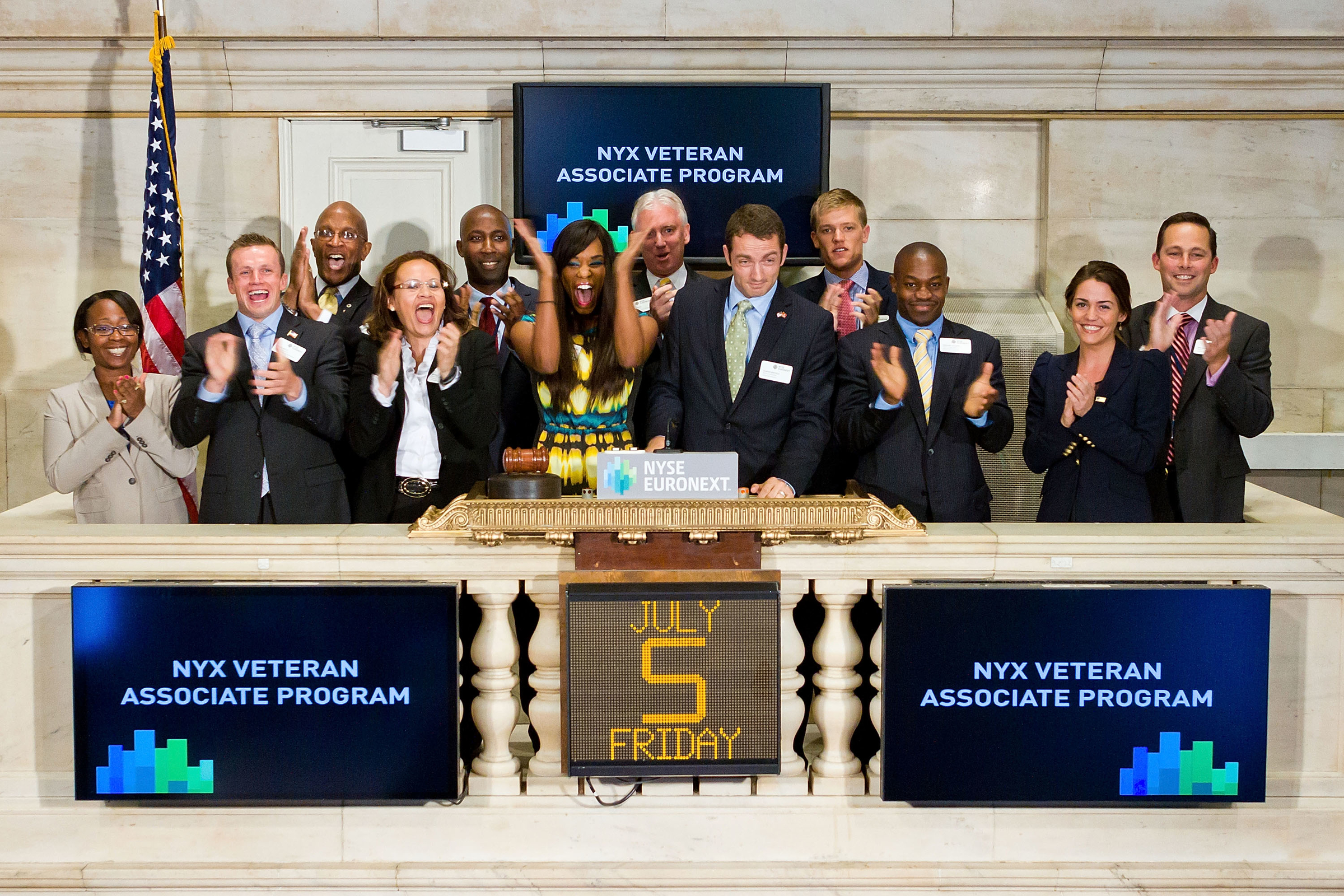
– March 2013. I became an independent consultant working directly for the New York Stock Exchange providing National Talent Acquisition work. Perhaps the best kept secret was that my time at the NYSE provided far more value to me than I could have ever provided to them.
NYSE Euronext celebrates 2nd Annual Veteran Associates Program
– March 2013 – Sept 2013. Eventually I started working full-time for the NYSE, as a Talent Acquisition Associate and a Veteran Associate as a part of their amazing Veteran Associate Program. I worked directly for the man who became the most integral and influential person in my transition to the “civilian world”. I was able to work additionally on Veteran efforts at the NYSE and in outreach of the NYSE to other companies such as AIG and Bloomberg, along with many additional partnerships.
– October 2013. HUGE MONTH. After recognizing my desire to continue and develop my career in Talent Acquisition, I was referred to, interviewed for, and offered a role in Talent Acquisition at AIG. Needless to say – I took it and am working diligently with my team’s objectives and additionally to build an official Military Veteran recruitment and retention strategy with partnerships across the corporation. I also took on a role as a Mentor and Guest instructor for the FourBlock Foundation’s Career Development course for Veterans. I provided resume review and assistance, and instructed on personal branding and goal setting. I am not sure who gained more from the experience, myself or the students!
Back to my fear – It is now a motivation. I may have lived through my most rewarding and impactful portion of my life… to date. That just means the bar has been set, and now I have to set goals and objectives that will allow me to live a life that only grows and progresses. For 2014 here is my “Bucket List” along with objectives and goals that will help me to reach new levels.
Goal: Begin my MBA at NYU
– Objective 1: Study for GMAT
– Objective 2: Complete GMAT with a score above 650
– Objective 3: Apply to NYU Stern School of Business Part-Time (3 year) MBA Program by the May 15th deadline
Goal: Meet face to face with my company’s CEO, Robert Benmosche
– Objective 1: Have a reason to meet with him (Official Veteran Program at AIG). Meaning, he has to be aware of the work being done on the topic. Which means, the work has to be solid, and provide value.
– Objective 2: Complete planning and execution of a series of Veteran Initiatives in collaboration with Talent Acquisition, Talent Management, Business Lines, and Diversity & Inclusion at AIG. (I cannot make public statements about everything just yet).
Goal: Travel Outside of the Continental U.S.
– Objective 1: Obtain a Passport. (I’ve never had one, but just submitted my application last week!)
– Objective 2: Complete a work related travel event outside of the U.S. (Likely to happen if I go to an event in one of our Canadian offices).
– Objective 3: Go on an out of the country trip for FUN! More specifically, a spontaneous location in the Caribbean, as my wife and I will be celebrating our TENTH Anniversary this Spring! I think at least a 2-3 night trip is feasible. Any LifebyDamien fans with connections or recommendations – please speak up! J
Goal: Write, Produce, Record and Master a complete song.
– Objective 1: Learn to play at least 2 complete songs on the guitar
– Objective 2: Obtain an intermediate-hobbyist level of expertise with ProTools and the MIDI equipment I currently have
– Objective 2: Upgrade my computer to handle the additional work-load.
Goal: Buy a House (Either single-family to live in, or Multi-Family to live in and begin a rental income investment)
– Objective 1: Build savings to cover all up-front costs (Will be using VA Loan)
– Objective 2: Identify investable markets (we have some areas picked out, but the idea of a multi-family unit within the city is a new development).
Goal: Begin Writing a Book
– Objective 1: Identify WHAT?! I have had this idea for a long while, and I have been very creative in trying to identify a topic. I’ve really considered all sorts of angles, so ideas are welcomed. So far, I’ve considered:
Memoir of my military career
Memoir of my transition process with a focus on the psychology involved
Taking all of my LifebyDamien articles and tying them together
Erotic Fiction (sex sells right?)
Personal Branding for those who don’t know personal branding
Any sort of random e-book to test the waters
– Objective 2: Start writing
– Objective 3: Get someone to read an initial manuscript
– Objective 4: Include writing courses as part of my MBA curriculum/electives
There are more I am sure, but not sure how to articulate. But to wrap up, here are some ideas I am considering, that are more “Bucket List” items – that if any fans are considering also, perhaps we can go in on a joint venture?
Skydiving (Have jumped with a static-line in U.S. Army Airborne school, but never free-fall)
Scuba Diving (Never have)
Family Cabin trip to the mountains, fishing, hiking, etc
Family Trip to Florida (undecided whether to make it a road-trip or fly)
Knicks Game and Madison Square Garden
Nets Game at Barclay’s
Yankees Game
Jets or Giants game at MetLife Stadium
Well – in 2013 I’ve taken my fear and turned it into motivation. What are you doing for 2014?
As a father of two, the quality of my children’s education both academically and socially is at the top of my priority list. As I sit waiting on a flight, and begin reading Emily King’s book “Field Tested” I am reminded of a conversation I had with my wife.
After exiting the military and leaving Camp Pendleton and the accompanying Oceanside, CA public school system, my son began school in a NYC Public Elementary School in The Bronx, NY. Needless to say, he immediately noticed a difference, and he was in the first grade. We expected a culture change, and perhaps methodology, but I have begun to notice something else is not just different, but missing.
The Marine Corps is full of A-type, competitive personalities that enjoy pushing each other to be better. Where one isn’t faulted for an inability, but if they aren’t in an active effort to be better. That culture… a culture of ambition is translated to the children of service members – especially the children of Marines 😉 However, sadly enough, I don’t see that same culture of ambition in my son’s (and now daughter’s) elementary school. A culture of ambition is exactly what drives individuals to perform beyond expectations – in any setting, school, work, recreation or otherwise.
Usually I like to propose a solution before ending an article, but as I sit, awaiting my flight – this is something I need to think about more. Where did the Culture of Ambition go? More importantly, how does one, a team, or an organization develop, maintain and nourish a Culture of Ambition?
The United States Marine Corps awards the right to carry the “Mameluke” Sword (Seen in Chrome and Gold) to Commissioned and Warrant Officers. The Marine Officer’s Sword commemorates the jeweled Mameluke sword that was awarded to Lt. Presley O’Bannon after leading a small Marine Detachment to march over 550 miles through the desert before attacking and retaking the enemy’s, heavily-fortified, Derna, Tripoli position.
The Commissioned Officers’ Mameluke Sword and the Marine Enlisted’s “NCO Sword”
Today we focus on the Junior Military Officers [JMOs]:
So, let’s briefly go over the profile of a Jr. Military Officer. I have to admit – I am not as excited about this group as I am the Jr. Military Enlisted – but that doesn’t make them ANY less valuable to the workforce. On the contrary, my reduced enthusiasm is because JMOs are SO well positioned to take on roles in Corporate America!
First – the hard numbers. When I refer to JMOs, I am referring to the bell of the curve for officers that: – Commissioned after earning a degree and have not had prior military experience as a JME – Served honorably for 4-12 years (considering those under 4 years doesn’t help as they are under obligation to serve for a minimum of 4 years, and frequently longer). – Previous salary ranging from $66k-$101k/yr (Tax adjusted equivalent: $74k-$115k/yr) – Make up less than 10% of the Active Duty Military
JMOs Typically – Directly responsible for Assets and equipment usually ranging in Millions to hundreds of millions of dollars. – Responsible for 5-150 personnel – Have had unparalleled leadership training, and leadership-development training to include proper implementation of performance evaluations, and performance evaluation systems. – Have hands on experience in organizational change and change management – Have “Employee Relations” and Human Resources expertise regardless of their military specialty – Have at least a SECRET DoD security clearance
Depending on the service, many JMOs will have a degree that is relative to their career field. The Navy is the service where this is most common. The Marine Corps would be on the opposite spectrum, as Military Occupational Specialties (jobs) for Marine Officers are assigned based on the needs of the Service, with respect to the Marine’s most desired role, and their performance. At the same time, The Marine Corps is the only service that requires ALL Officers regardless of job, to attend the world’s highest rated leadership course, known simply as “The Basic School” [TBS].
From every civilian organization I have had conversations with, I hear a common theme – It is not so difficult to find someone great at their job; it is ever-difficult to find an effective leader that develops members of the organization at the team level. In civilian organizations, the logic follows “I’m the best at what I do, and I have earned the right to be promoted into a Sr. role”. That may be true – but technical expertise and leadership are far different. JMOs are taught to lead FIRST. Then they are given the tools of their trades. Marine Officers spend 6 months, 60-100 hours per week, training with peers – solely on LEADERSHIP, refining their ability to develop OTHERS. They are the Michael Jordan of corporate employees. When they are on the court, the rest of the team plays better!
JMOs have experience in developing and being held responsible for the development of protégés, and the junior members of their organization. Their measure of performance is based on their team. This is a trait normally reserved for very senior and C-suite executives. It doesn’t have to be – a JMO is willing and able to fill the void your organization has in developing it’s young talent, creating organizational loyalty, commitment, and efficacy.
When reviewing the resume of a JMO, or interviewing them and you notice a specific job skill they don’t have enough “experience” with – ask yourself: Which will cost my organization more, teaching him how to use Salesforce, or sending my Salesforce Admin to six months of leadership training and a following 3 years of practical application? You can hire one technical expert, and you’ve gained one savvy technical expert for your job field. You hire a JMO, and you gain a team of motivated members of the organization; all constantly being challenged to perfect and grow their technical expertise.
The United States Marine Corps awards the right to carry the “Non-Commissioned Officer’s” Sword (Seen in gold and black leather scabbard) to those Enlisted Marines once they obtain the rank of Corporal (E-4). The Marine NCO-Sword is the oldest weapon in continuous service in the U.S. inventory.
The Commissioned Officers’ Mameluke Sword and the Marine Enlisted’s “NCO Sword”
Today we focus on the Junior Military Enlisted:
According to the most recently available (2011), complete figures I could obtain per the Dept. of Veteran Affairs, Junior Military Enlisted service members (Those enlisted members with 4-12 years of service, and in the ranks E-3 to E6) make up nearly 50% of the Military’s force. That is the single largest group of any of the four groups described last week.
First, to reduce risk of carpal tunnel, I will refer to a Junior Military Enlisted service-member, or a Veteran of that group, as “a JME”. The typical JME has spent 4-12 years on Active duty in the military and in addition to being immersed in leadership training that entire time, they have spent 2-10 of those years in a leadership role. During which time they have been responsible for up to 30 direct reports (in cases much higher, and in cases never more than a handful).
JMEs with this leadership experience are experts at handling ambiguous situations and making decisions based on what they best understand their superior’s goal or intent to be. This translates into becoming a manager in a larger corporation that can lead and employ his team, setting and meeting team objectives that are aligned with the organization’s strategic vision. In the military we like to refer to it as “Understanding a clear Commander’s Intent while operating in a decentralized command structure”.
With the fruition of the Post 9/11 GI-Bill, JMEs are able to pursue higher education at amazing rates. Based on size alone, separating JMEs who pursue higher-education vs. those who don’t would constitute adding a 5th group. For ease of identification we will remain with four. However, from this point forward, I will refer to solely the group of JMEs who pursue higher-education.
For the corporate world, where a Bachelor’s degree is required for employment, seeing a JME with a degree or in pursuit thereof is a great signal! This means they are already demonstrating a prized leadership quality – Know yourself and seek self-improvement. Not to mention they have taken Initiative to do so, maintain an internal locus of control, and are combating the ambiguity of financial pressures and security in order to complete their education as opposed to looking for immediate financial gain. This is a distinction worth noting.
JMEs are SEVEN TIMES more plentiful than Jr. Military Officers (JMOs), and bare the same leadership and educational experience after completion of their degree. It should be said however, that JMOs get more formal training in the honing and development of their leadership abilities.
To wrap things up, here are two points that are often over-looked by under-exposed and improperly educated Recruiting “Professionals”, often those who will only recruit or who have “clients” that will only hire prior “commissioned officers”:
Formally, Staff-NCOs (Ranks E-6 and above) are charged with the development and mentorship of all JMOs until the rank of Major/Lieutenant Commander (O-4). In practice, JMOs until the rank of Captain/Lieutenant (O-3) receive constant mentorship and development from JMOs (E-4 and above). Yes – these NCOs or JME are exactly who have been developing these highly sought after JMOs!
A typical JMO that gets out of the military after 4 or 8 years of service has earned a degree, and THEN gained his leadership training. A JME who pursues higher-education will have received his leadership training first and then receives the most current in academic training while earning a degree.
I’d like to leave our brief description of the JME at that. Next week, I will even things out a bit by diving further into the unique and valuable assets the JMO offers employers in today’s corporate world.
Until then, I hope to see as many Veteran seeking, or knowledge hungry Human Resource Professionals at the NYSE 2nd Annual Call to Action Forum on Nov. 1st at the New York Stock Exchange in New York, NY!
Overly delayed, but as promised, let’s start looking at the different profiles a high-potential U.S. Military Veteran will likely fall into. I like to give a broad breakdown of the Veteran Profiles that are most likely to be seeking to enter the non-military workforce. In doing so, there are four main groups. I have also described and made the case for one of the four groups in the recently released Hiring Manager Resources published on the New York Stock Exchange Website (I’ll link the work at the end of this article).
The Commissioned Officers’ Mameluke Sword and the Marine Enlisted’s “NCO Sword”
The four main groups of Non-Retiring Veterans are:
– Senior Military Officers (SMO)
– Junior Military Officers (JMO)
– Senior Military Enlisted (SME)
– Junior Military Enlisted (JME)
Many have heard of the JMO, as they have become a highly targeted candidate pool for both corporations and placement agencies alike. Where else can you find a pool of talent with post-degree work experience, and a resume of leadership and responsibility that often includes multi-million dollars in assets and organizational command often exceeds 300 people? The problem is, they only represent 7% of the military – and not all 7% exit the military. The amount of JMOs actually exiting the military is closer to 2% of the entire military assuming 67% of the military’s JMOs are retained after their first 4 years of service.
For the following summary and description of each group, I will be referencing my own work as published on the New York Stock Exchange website. Not every member of the military will perfectly fall into the following four groups. However, for organizations looking to hire Veterans, a clear understanding of the following groups will best prepare you to close the communication gap, and understand the majority of the Veteran population that are currently entering the workforce.
Four Main Categories of Non-Retiring Veterans
SMO – Sr. Military Officers (Executive Group)
12+ years of service
Often with Master’s credentials and positioned well for Executive and Fast-track leadership programs
JMO – Jr. Military Officers (Professional Group)
4-8 years as a Commissioned Officer
Highly sought after professional group for Junior and Mid-level Management roles in med-large companies
SME – Sr. Military Enlisted (Skilled Group)
12+ years of service
Various levels of education and degree progress
Often are technical-skilled experts in their job field
JME – Jr. Military Enlisted (Skilled Group – Early Growth Stage)
4-8 years of service
Mostly hold a High School diploma upon exit, if not a GED.
This group is further broken into two categories:
JME pursuing/has a degree
JME not pursuing a degree
You will notice that “JME pursuing/has a degree” is bolded. That is because it represents the most under-targeted group that I argue should be considered as equally positioned to JMOs when considered for entry-level and junior leadership roles requiring a degree. JME within our targeted service time of between 4-8 years of military service make up nearly 50% of the military per 2011 numbers! That is SEVEN times more than the JMOs. Additionally, with the onset of the Post-9/11 GI Bill, JMEs are pursuing college degrees at the highest rates seen in history.
This unique set of circumstance creates a large pool of candidates with 4-8 years of leadership training and experience that is unparalleled outside of the military. Of which many have now earned or are near completion of a degree with the most current curriculum in academia. Where else can you find a degree holding candidate, with a Quarter-Million-Dollar leadership education and looking to start their career at a salary under $60k/yr? No Ivy-league school can compete with that.
Stay tuned for next week, as I compare and contrast the great assets both Junior Military Officers and Junior Military Enlisted offer while also giving a more in-depth description of each group. If you can’t wait until then – feed your curiosity by visiting The Veteran Associate Program page on the New York Stock Exchange Website.
Yes – I work personally and professionally to place Veterans into Corporate America by educating employers and coaching Veterans in their transition process… and I’m telling you NOT to hire that Veteran. I will explain.
The momentum continues to build as I work to help Veterans transition and encourage Employers to take advantage of the amazing talents Veterans offer! When I present to a company I am all passion and rightfully so. To ensure my message is not clouded by any elephants I need to address the issue of the the Vets that don’t provide value. There is nothing patriotic about keeping a Veteran that subtracts value from your organization – so don’t.
Jack Welch made a practice of releasing the bottom 10% of his company annually; Jim Collins (in his award winning book, “Good to Great”) will tell you that “Great” companies will make sure the right people are on the bus and the wrong people are kicked off the bus. No organization is 100% effective and I won’t preach that U.S. Military Vets are any different. I WILL tell you that there are far too many outstandingly qualified and high performing Veterans out there that you should never be holding onto a less than ABOVE-average performing Veteran out of “Patriotic Duty”. All they do is give a poor and inaccurate representation of Veterans in the work force.
There is much to be said about how to spot accurate flags to weed out the “bottom 10%” early in the process; more so than will be written here today. There are 3 primary reasons a Veteran is underperforming.
1. The Veteran is poorly matched to their job role (this can happen anywhere, with any employee).
2. The Manager is weak. Yes, bluntly put – if the manager is not willing or able to identify sub-par performance and demand better, the Veteran will have a false sense of acceptable expectations (as would any employee). Veterans are diligent and will sacrifice for a greater goal – give them their goal!
3. The Veteran is in the “bottom 10%”. Get rid of him. Don’t let that Vet ruin it for other Vets. Of course as with any employee, due diligence should be administered in ensuring this is the problem before making a decision to terminate.
Now that we have the elephant addressed, stay tuned as I start my next series of articles on the profiles of Veterans and how each fit into and add above-average value to your organization!
Posted on the go from my Droid RAZR, technology is our friend!






 Learning, Leading & Life
You must be logged in to post a comment.