Can I Ring Your Bell?

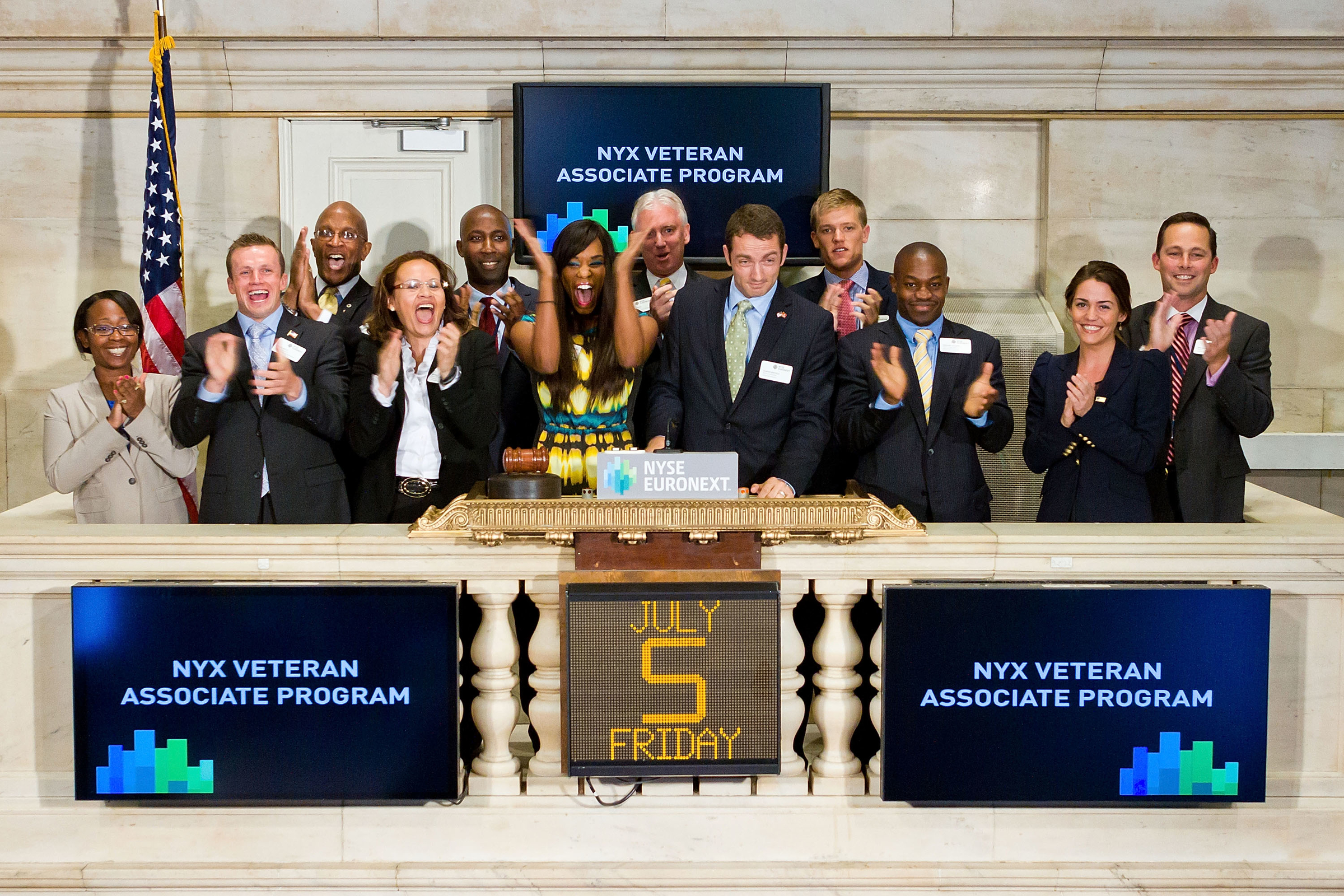
NYSE Euronext celebrates 2nd Annual Veteran Associates Program
NYSE Euronext celebrates 2nd Annual Veteran Associates Program – Photo Credit to Ben Hider at Ben Hider Photography

Through an initial vision, or a Call-to-Action of NYSE Euronext CEO, Duncan Niederauer – the NYSE developed the Veteran’s Associate Program.  After Niederauer’s idea was relayed to the Human Resources department, a program was developed from the ground up and implemented for the first time in June 2012.  The program offers a paid internship to Veterans of the U.S. Armed Forces who are currently seeking or have recently received a degree.  It provides key exposure, education and experience in the corporate world to Veterans.  The Veterans, effectively demonstrate their value by demonstrating the high-value, highly sought after, intangible traits they have developed during their military careers.  These are the same traits that have made Veteran Specific recruitment a multi-million dollar industry for multiple agencies across the nation.

Now that there is some perspective, I wanted to boast a little bit about an amazing experience.  I also wanted to include the first ever, YouTube videos on LifebyDamien.com.  Below you will find the recordings of U.S. Military Veterans ringing the closing bell of the New York Stock Exchange.  You can find me in the July 5th closing, front and center as I push the button to ring the bell and my adjacent colleague strikes the gavel.

I have included all 3 closing bell ceremonies as participants of the 2013 Veteran Associate Program were part of, if not the entirety of each bell ringing.  Lastly, I have included a brief video documenting the 2012 Veteran Associate Program’s Inaugural class, and their closing bell ceremony.

Learn more about the Veteran Associate Program, and how to create a Value-driving program in your organization at the NYSE Veteran Programs and Initiatives page.

July 10th, 2013 – Celebrating the Veteran Associate Program 2013

July 5th, 2013 – Celebrating the Veteran Associate Program 2013

June 14th, 2013 – Celebrating the U.S. Army 238th Birthday with Members of the VAP 2013

As promised, Celebrating the Inaugural Veteran Associate Program, July 5th, 2012

The Scariest News I’ve Heard…

I have published a handful of articles here on LifebyDamien.com that revolve around the phenomena of social interaction and interpersonal skills (namely their importance on a society).  That said, I feel like today’s article is applicable, provides value, and provokes thought.

I’ve began listening to the WSJ podcasts, and just a couple of weeks ago, I heard a story about the first class of students to graduate high school, from a 100% online curriculum starting from Kindergarten.  Wow.  That is one heck of a display of technological advancement!  For the life of me, I cannot find the article in print, online. I wanted to see what colleges some of the graduates were going to, and see what statistics could be had from the group.  But I am a bit concerned.

My first concern was, “How are these kids going to know how to interact with other people?”  Well, the founder of the institution was quick to address that all the students were given even greater chances of social interaction because the online curriculum allowed more convenience for travel and social clubs such as Cub Scouts, Camps, etc.  I’m a bit skeptical.

Some of you may recall my article “It’s not Education, it’s a Distraction”, where I emphasize the importance of a structured education environment not being the academia, but the social skills obtained when placed among a DIVERSE group of persons.  These online graduates, from their earliest stages, are sheltered from adverse social interaction, and are allowed, by default, to only learn how to interact with filtered groups of their own choosing (or their parents choosing).  How are these children to learn appropriate interpersonal skills for dealing with adverse and vastly differ-minded individuals?  When will they get their experience? At college? Or will that be all online also?

I would love to get Malcom Gladwell’s take on it.  If “The Rosetan Mystery” as described in the intro to his NY Times Best-Selling book, Outliers, has any truth, there may be great cause of concern.  The medical mystery of the Rosetan Italians of Pennsylvania took in a diet where 41% of calories came from fat, and they maintained the lowest levels of heart disease than any community in the nation! Arguably due to their Social and inter-personal activity and function as a community.

My concern here is that our own technological advances are numbing us to CRITICAL aspects of social and medical health for humans – Social Interaction.  Further, I am concerned that through the strict selection of those we expose ourselves to (such as in this instance where one selects to interact only in specific social settings) will further segment the social landscape, and reduce our ability to see, accept, and make advancements from differences in social make-up, adversity, and what makes America – Diversity.

I’m not overly religious, and I don’t use the following quote to be so (I’ll probably quote it incorrectly), but it applies: “The greatest feat the Devil ever pulled was making people believe he didn’t exist”.  Regardless of religious belief, it is a great example.  Are we slowly reducing ourselves as a nation, and as Society while we are leading ourselves to believe that we are advancing?

*Photography Credit: Ben Hider Photography Taken 6/28/2013 (Opinions and sentiments of this article, or LifebyDamien.com, in no way reflect that, or represent the opinions, sentiments or positions of Ben Hider Photography.  Ben just takes great photos!)

Hard Truth Veterans Must Know – Employers & Recruiters Must Admit To

Followers of LifebyDamien.com have a fair understanding of my passion for placing well qualified Veterans into the opportunities they have earned and demonstrate themselves uniquely qualified to take advantage of.  It is my passion for the success of my fellow Veterans, and my dislike for the distaste of those who are strictly trying to extort the new buzzword/phrase “Returning Veterans” that leads to today’s article.

First, to my fellow Veterans – Be Warned.  Recruiting firms, more often than not are in this game for Money – Period.  Any marketing plot that will bring them money in the nation’s fastest growing industry in the 2000s (Based on $ spent by major corporations) is fair game.  Placing qualified Veterans is a HUGELY marketable ploy for many reasons.  The main reasons include that many Vets leave the military with unique skills, traits, talents and qualifications that make them the perfect walk-on candidate for DoD jobs, Contractor Jobs, and additional spaces through-out.  There is also the appeal it has to the general public that a company “supports our troops” and is “committed to returning Veterans”.  The truth is, FAR too many of these companies are making claims of commitment, yet they have ZERO or negating proof to support such statements.

Recruiting Agencies, Staffing Firms, Placement agencies… are in it to make money.  Many which try to market themselves as “Veteran friendly”, are using the buzzwords and nothing more.  They have no idea, have not studied, and are careless in truly understanding why Veterans are unique in the traits they bare in addition to the skills acquired.  There is an AMAZING, and overly under-known agency, The Institute for Veterans and Military Families, that has completed and shared empirical research that speaks directly to the FINANCIALLY supported arguments that Veterans make high-value candidates for many of the roles in today’s business world and beyond.  The information is out there – it can be supported!  But don’t be fooled into thinking that all agencies are created equal and will have the knowledge equipped to help you, and guide you, as well as present you to employers.  If this raises question marks behind your brow – please do not hesitate to contact me directly.  I will work with you, do what I can – and it doesn’t cost you a thing!

EMPLOYERS:  Yes – be cautioned.  “Knowing a Veteran”, or just getting excited because your multi-thousand dollar resume screening software found a resume that belongs to a Veteran does NOT make you “Committed to Veterans”.  It doesn’t.  If you would like a start in the right direction, send one of your recruiters to the Certified Veteran Recruiting Program written by Emily King.  It’ll cost you upwards of $3000 or more including tuition, travel and stay for your employee, but that is a drop in the bucket compared to one placement isn’t it?  And what about the lifetime value of a new client that values your demonstrated commitment to Veterans and your quality service in its regard to the clients need and desire to hire Veterans?  Your recruiter will at least have had some sort of formal education to understand Veteran Transitions.  A returning Veteran is more than a catch phrase to add to your write-up when presenting a candidate.  Do your research, and then back it up with ACTION!  Action first, then profess whatever commitment you have demonstrated.  An idea without action is not commitment, it is an idea.

Employers, if you truly do want to crack the puzzle and understand how sourcing, presenting and developing Veterans within an organization is legitimately a smart business move that cannot be ignored, contact me – as I can provide consultation.  I know there are HR teams, and organizations that want to be a part of hiring well qualified, high-potential candidates into their organizations and are genuine in doing so.  I am more than happy to help.  If you are looking for your next gimmick, and aren’t ready to make a true commitment – please continue past and come back when you are ready.

For the record, there are some amazing Veteran focused recruiting firms out there, that TRULY know what they are doing, and they have developed relationships with organizations and companies that also want to make true commitments, while also seeing the great value of bringing Veterans into their organizations.  HirePurpose is one – and by the way, the Founder is a former Marine.  Four Block is another amazing organization – Leading Co-Founder, a former Marine, with co-founding Navy and Army counterparts.  Emily King has revolutionized recruiting of Military Veterans at the Buller GroupDiversant has developed an amazing training and work-to-hire program.

There are many amazing companies doing amazing things such as GE, Macy’s and NYSE Euronext – but I cannot forget to add the amazing effort of networking and coordination for those who truly want to be a piece of solution, and that is the team at GoldenOrb.org.

I always welcome feedback, whether in support of my argument, or in support of higher learning through constructive argument.  I am not a fan of Group Think.

Please, don’t forget to stay in touch with me on LinkedIn and follow me on Twitter, @Mr_DamienB

Lose Control, Gain Influence

I like to be adventurous sometimes… and this is something that has come to mind and I’ve noticed in Global, Political and local context.  So I’d like to address it some, and briefly apply it to team building and entry-level leadership and manager roles.

Human people, as a mass, are control freaks.  We will always try to find blame for bad things on attributes which can be controlled, or that we at least perceive we can control.  It gives us peace of mind to think we can do something to prevent the recurrence of a mal-event.

It is much less likely for people in mass, to attribute mal-events to forces that are much more difficult to control, require a shift in thought in order to control, or are simply not controllable.  The only exceptions to this rule are those mal-events that are results of natural disasters.  Even then, there will be those that will try to rationalize that any negative effects of the natural disaster were preventable, or controllable, based on some aspect of human error.

We as people are horrible at differentiating what CAN be influenced, and what CANNOT be influenced.  I use the word “influence” intentionally.  No single thing can be controlled, but it can be influenced.  And often, people over-look the ability of influence.  The best influences are those that are never realized, yet effect the decisions and the results of events.

To this, I say – always seek out and diligently identify any contributing factors to an outcome, if you are looking to effect the outcome.  This works in micro and macro applications.  When managing a team and you notice a lack, or shift in performance or results, first identify all contributing factors (team members, member’s work environment, your implicit signals, members’ home environments, etc).  Then, analyze where you should focus your INFLUENCE (not “control”).

Well placed influence will always reap a higher return and more efficient results than emplacing “controls” or “exercising control”.  If you feel like you’ve lost “control” of your team – change your mindset.  Stop trying to control people and control the environment and start influencing people and harboring the environment.  The best part of influencing anyone or anything – effectively influencing forces you to listen, comprehend, and understand the subject of your intended influence.

How do you influence others?

Common Goal or Common Enemy

There has been a lot posted lately about my efforts in Veterans Transitions – and there will be more.  But today, I wanted to take a step back and bring up something that has more to do with general Leadership and Team Building.

While there are many “definitions” of Leadership – most generally focus around the idea of organizing a group of individuals into a team with the focus of reaching a common goal.   Most importantly – there is a focus on a common goal.  There are many studies, theories and methodologies out there that speak to the multitude of motivational theories and personality matching that goes into building a cohesive team that will reach and set new goals.  For fun, I’m going to dumb-down to look at a comparison.

I’ve seen motivation of 2 or more individuals based on their desire to achieve a goal that benefits both to a level greater than could be obtainable if each attempted to do so on their own (This would suggest synergy – a more comprehensive and overall better explanation can be taken from Stephen Covey’s The 3rd Alternative.  Is the bond, and level of cohesion in that scenario as strong, stronger, or inferior to the bond and level of cohesion obtained when 2 or more are united by a common enemy?

Now I have thought about this… and I am not sure which is more powerful in the long run.  However, in thought – I believe being united by a common enemy is often more influential and bonding when dealing with a diverse group of individuals with pre-existing aversions towards each other.  I’ve also seen many examples of manipulating individuals into bonding through the threat of a common enemy – as I am sure most of you have.  Let’s look at some.

If you have had siblings – How many times were you and your sibling punished after bickering or fighting by your parents?  So much so that the punishment dealt by your parents made you and your sibling work together to bare the punishment, or even more so, try to out-smart your parent – after such you and your sibling(s) were left with a tighter bond and deeper understanding of each other?

If you are in a direct sales role, where multiple sales teams operate in the same region – there is that one sales team that always wins the contests and bonuses.  You find yourself teaming up and sharing ideas with another team – that would normally be competition, almost solely for the sake of keeping the top team from winning once again.

In the military – it happens EVERY DAY at the ground roots.  In one of the finest and most renowned leadership courses our nation has seen, high school graduates by the hundreds, from all over the nation land on yellow foot prints at the Marine Corps Recruit Depot in San Diego or Parris Island.  Many times with the testosterone drive, A-type personalities sought after by USMC recruiters.  Once assigned to a platoon, before they can figure out if they like each other or not – recruits realize their greatest, and only ally against the wrath of Drill Instructors is each other.  If you’ve yet to see what Recruits will do, as a cohesive unit, in an effort to avoid the wrath or even further impress their Drill Instructors – you might be grossly underestimating the power of unity through a common “enemy”.

Anyhow, there are many ways to motivate a group of individuals in order to create a team.  But many of the most cohesive, successful and well-oiled teams I’ve formed, been a part of, or observed have all at some point, experienced a period of bonding induced by their own unity against a common enemy.  By no means is that the solution to building a team – but a very interesting piece of the puzzle to be considered.


How have you seen it in your situation?

A New Approach to Veteran’s Transitions – Fire and Maneuver

Deltas Walking
My Last Day in Uniform along side my Transition Support Team.

While I decide on the next series of articles for LifebyDamien, I wanted to give an update on the world of Damien Bertolo as it will affect the focus of the next series of articles.

As those of you who follow are aware, I was working to build a Veteran Recruitment Division for a Staffing Agency in Manhattan.  While continuing on with that division is no longer in the immediate future plans for that agency, I have been debating the depth at which I will continue to move forward with it.  As it stands, I intend to work on two “fronts”.  First, I will focus my efforts, as an Independent Consultant, to help employers develop hiring, and on-boarding programs that will provide opportunities to Veterans. Second, I will use my own personal time, at no charge (in sort of an unofficial, self-funded NFP function) to aid Veterans who are transitioning out of the military.

Currently, I will be working for the New York Stock Exchange as in Independent Consultant, aiding (while also learning) in their Talent Acquisition of qualified candidates for needed roles.  I am very excited to be offered this opportunity as it provides benefits to me on MANY fronts!

To continue consulting additional organizations, I want to move away from Talent Acquisition, aka Recruiting, in an operational function.  Instead of giving employers “fish” when they are hungry, I want to give them the pole, line and tackle box.  From those I have talked to, it seems employers don’t have a solid grasp on how to identify the solid Veteran Talent, how to interview Combat Veterans, what to look for, what to dismiss, and what to keep.  I’d like to help employers develop their HR functions to be able to do all of the above, successfully.  This way they will see the direct, short and long-term value that the unique traits offered by Veterans provide to an organization.  Then they can continue with their efforts long after I am gone and WITHOUT having to pay a recruiter fee each time they are seeking a qualified Veteran to add to their organization.

As a Not-For-Profit function, I haven’t decided on a name, but I am thinking “DPB Transitions” might be it.  I have already done it before, and I’d like to position myself to do even more of it in an official capacity.  I want to help Veterans see the smoothest of transitions to the “civilian world” as possible.  In an effort to do so, I intend to offer my knowledge learned in HR, recruiting, and professional development to pass on to Vets, so they aren’t reinventing the wheel.  I will offer my help, and my network to any Vet transitioning.  This includes but is not limited to, Networking, Resume Construction (not just a template, but actually understanding the coded 8.5” x 11” grail), Interview Prep, Salary Negotiations, Professional Development, Life Coaching and any additional odds and ends that help the Veteran stay focused on a successful mission of transition.

Why do I think my two-laned approach will work?  Simple – this is Fire and Maneuver, not Attrition, nor Fire and Movement.  When a Recruiting Agency markets their military talent, they offer it one time, with one success per contract, and more importantly, one fee.  They will seek through as many candidates as possible until they find one that “makes it through the lines” and gets placed (Attrition, or maybe Fire and Movement if actually done well).

I will develop a sense of employers’ needs, through consulting and developing their HR functions with the ability to seek, screen and on-board Veterans. This gives me a look at the clients’ positions.  In Military tactics jargon – I’m turning the map around.  Then, I am in touch with Military Talent, Veterans eager to be of value to society.  I am able to help them, and guide them, with the insider’s view of the other side of the “battlefield”.  Then, Employers can trust I will refer quality talent to them, without any fees per hire.  I pin down the employers needs as a Consultant; and I aid the Veterans to move around and penetrate their lines (get hired) as a NPO – Fire and Maneuver.

Advice, support and resources to recommend are always appreciated!

Don’t forget, find me at: Damien B on LinkedIn or on Twitter @Mr_DamienB

My Personal Brand Part III (From a Brand You Are Given to a Brand You Will Name)

My Personal Brand Part III (Veterans transitioning; from a brand you are given to a Brand you will name)

To conclude my three-part series of “My Personal Brand”, let’s discuss how the dynamics of personal branding changes for U.S. Military Veterans – or at least from my experience.  In the “civilian world”, when it comes to Branding, differentiation is critical.  Without differentiation, your brand is weak and you are not much more than a commodity in your industry – just another number.  In the military, differentiation is largely frowned upon.  Members of the military are the epitome of conformity and uniformity. The only approved and sought after differentiation supported and condoned is that which is based on merit and performance.  It is okay to stand out because your performance is above that of your peers.  Beyond that – don’t try to be different.

To the public eye, a Marine, in or out of uniform is first and foremost a Marine.  Your attributes, both good and bad are first accredited to the Marine Corps and THEN you are considered as a person.  In the Corporate World, an employee’s attributes are accredited FIRST to his personal brand and THEN to his organization.  This is a vital shift in perspective and dynamics that must be understood by Transitioning Veterans.  A Veteran can no longer assume that being part of a successful organization will result in the assumption that he or she is successful as a person.  Rather, an organization will look at your personal brand, and if your brand will contribute to the organization’s success.  From that point forward, your actions will define a brand that is associated with you.  Do you care about money? Do you care about philanthropy?  Can you be trusted? Are you good at your job? Are you dependable?  Anything you do will shape, mold and detail your brand both personally and professionally and you are the SOLE PROPRIETOR responsible for all operations, execution and public relations regarding “I Incorporated” branding.

Professionally, there are two major areas to develop in your brand: Skills and Traits.  This is an idea I came up with while building the Veteran’s Recruiting Division (an architecture I will be using to help Veterans transition).  Skills are those abilities that we can learn in class, through practice, and are taught – often in an academic environment.  One can be taught out to add, type, send emails, develop databases, etc.  There are MS Office skills, athletic skills, software development, writing code, completing a SWOT analysis, folding a t-shirt, etc.  Traits cannot be taught in a classroom.  Traits are embedded abilities, developed over time and speak to a person’s character.  These are abilities that have to be ingrained  trained over time and reinforced through habit and ultimately retained through confidence in their importance to the quality of one’s personal brand.  To give a specific example, the Marine Corps has what they call “14 Leadership Traits”:

–          Judgment

–          Justice

–          Dependability

–          Integrity

–          Decisiveness

–          Tact

–          Initiative

–          Endurance

–          Bearing

–          Unselfishness

–          Courage

–          Knowledge

–          Loyalty

–          Enthusiasm

Having favorable strength in these areas is not something one can build in a classroom.  Traits are force multipliers that vastly improve the efficacy of skill.  The fiscal investment needed to build or develop traits like those listed is far more extensive than any certificate course.  Traits are what Veterans bring to the table. Traits are what Veterans, and most Employers alike, don’t know how to translate in a resume.  It is these traits that will be the guide for Veterans to build their personal brands upon.  Understanding the traits and applying them accordingly is what will build the individual brands of Veterans.  These traits are differentiators.  These traits make skills much easier to acquire and to sharpen.

Skills may provide immediate benefit, and the first 90-days of a job opportunity, but TRAITS are what employers and organizations are truly betting on and will determine success beyond the short-term.  Skills are also the medium in which traits are demonstrated. So it is also important for anyone who is trying to display or build their brand to understand, you may have to invest in your own ability to translate your value through appropriate skills.

Veterans – please remember:  You went from being in a scenario where everything you did gave credit to a brand you were PART OF.  Now you are in a scenario where everything you do DEFINES the brand which YOU are.  Also, trust that the contributions you made to your Service Brand have developed the traits that now define YOUR brand.

My Personal Brand Part II (Live by the sword, die by the sword)

“My Personal Brand Part II – Live by the sword, die by the sword”… or do you?

When Marketers, Public Relations Professionals, and the entertainment and sales industry in general speak about brand, they speak about the image of any one entity. Don’t they?  Yes, yes they do – much as I described in Part I.  There are many things that go into building a brand, and actions of that entity is one of them.  Media, be it internet, television, print, or even word of mouth, is an major avenue – a super highway – for communicating actions to the public. Talent aside (and in many cases not even needed) for those in the entertainment industry, the media is also the vehicle to success.

When you use a vehicle to get to work, and you are dependent on that vehicle to get you there – aren’t you also responsible for the maintenance and less glorified aspects of vehicle ownership?  Are you exempt from the oil changes?  Getting Gas?  Getting it washed?  What about getting a flat tire – as inconvenient as it might be, do you not still have to change it or call a tow?  Of course, we have to – it’s our vehicle to well-being, allows up to put food on the table and gets us to where we need to be in order to do our job successfully.  Does anyone ever look down on you for taking care of your vehicle?  Are you less successful because you had a flat tire?  I’ve never heard someone lose credibility for taking care of their vehicle.  I’ve never heard of anyone losing credibility because they had to take on the expenses of their vehicle for the sake of the benefits.  I have however seen people lose credibility because they felt they should be exempt for the expenses and deserved to still have the benefits.  If you stop putting oil in your car’s engine – no matter how great you are at your job, your vehicle will stop, and will not get you to work.

Case in point: Beyoncé.  She is an entertainer; media is her vehicle to success.  Media is not her job, rather singing and dancing is.  Through media, her vehicle, she has developed a brand which has allowed her to do additional branding and expand her brand and credibility.  She can definitely sing, and I haven’t heard an argument that could prove otherwise.

Round 1. – At the inauguration, she lip-synced the national anthem.  Be the circumstances what they were, I am not arguing whether that was smart or not.  However, when she chose not to address the allegations, and initially tried to pull it off allowing others to assume she sang live – she was neglecting her vehicle.  Had she tended to her vehicle immediately, it would not have been nearly the story.  But she didn’t, and like a tire low on air, it only gets worse.  She finally addressed it, but by the time she did, it was like changing a tire on the side of the road, when all she would have needed if done promptly, was put air in the tire.

Round 2. – Beyonce put on a great show at the Super Bowl half-time show.  After the Super Bowl was done and passed, a rather unflattering photo of her started to grow presence on the internet.  Again, Media, being her vehicle to success was in need of maintenance.  It’s fair to say, anyone who is in entertainment has had less than flattering pictures published, and they continue on. Especially of entertainers in the midst of a performance – it happens.  And there is nothing wrong with it.  It is a cost of maintaining the vehicle.  In this instance, Beyoncé (as has been rumored to happen in the past) went on a PR campaign to ask and persuade any website from hosting the picture.  In this, Beyoncé did not feel she was subject to the same costs of her vehicle, and that she shouldn’t have to bare it. She wanted someone else to do it. She wanted those who use the internet and ratings to take a hit on THEIR behalf for the sake of her benefit.  Sure, we’ve all asked for a ride from friends to get to work.  But how does it look when you have to ask for a colleague to drive you to work and drive out of their way – just because you don’t want to drive your car in the rain?

If you expect to reap the benefits of something, you have to accept the costs and responsibilities.  The moment you feel that you should be exempt from those responsibilities – you will start a slow deterioration of your brand – er… vehicle.  I think it would have come off better if Beyonce just made fun of her own picture – much the way Gov. Chris Christie ate a jelly filled donut on Letterman’s show.  Do I think her asking to have the picture taken down makes her any less talented? No.  But do I think it showed neglect and disrespect for her vehicle – same vehicle that has allowed her become the brand she has? Absolutely.

Know your brand, and respect the vehicles that have built it for you.  As soon as you lose respect for the vehicles you travel in, and the paths you’ve had to travel them on, you will lose credibility in your brand – don’t leave you brand counting on the jump-start of a passer-by.


Thoughts?

Stay tuned next week for Part III – Veterans transitioning; From a Brand You are Given, to a Brand You Will Name)

“I Incorporated” – What’s Your Brand?

My personal Brand Part I (Part I – of a three part series)

I was introduced to a concept called “I Incorporated” during my final year of college by one of my business professors, David Bennett.  It was mentioned often in our Career Development class.  Now, I had a concept of what it was before he mentioned it, but I didn’t have a title or a real grasp of it until then.  Since, I have found myself to be a very conscious purveyor of personal branding, or what “I Inc.” is referring to.

Branding is largely what differentiates products that would be commodities based on the consumers experience with that brand.  Or is it that unique experiences received by consumers through actively differentiating products that would be otherwise be commodities is “Branding”?  Maybe it works both ways.  For the sake of this article, the most important concept of branding in the larger sense is that Companies…ahem… successful companies, actively seek to provide their consumers with unique experiences through the companies’ products as an act of branding, in order to garner product and further, brand loyalty. The difficult thing about Personal Branding is regardless of what you say, your actions will constantly provide your audience data/information that will be used to make a conclusion about YOUR brand.

Jim Joseph, a Finalist for the 2013 PR News Social Media Icon of the Year Award, has a great series of books known as, “The Experience Effect” (you can see them listed here under Recommended Reading).  I believe a 3rd part to the series will be out soon enough.  Joseph starts the series with The Experience Effect with large scale branding.  The Experience Effect for Small Businesses is, well, self-explanatory.  The third – as I anticipate will follow the trend – and is sure to give great input on “I Incorporated”.

With this I ask: What do YOU want to be remembered for?  That is part of a brand isn’t it?  When you think of a brand, you don’t think of what they DO; you recall what you REMEMBER them for!

Let’s try it:

BP?…

Xyience?…

Exxon-Valdez?…

Coca-Cola?…

FEMA? …

Johnny Knoxville? …

Alright, the first things I recall: BP – Gulf Oil Spill, gas & snacks; Xyience – UFC, working out; Exxon-Valdez – Oil Spill in Alaska, Questionable drilling practices in South America; Coca-Cola – Caravan of lit-up Coca-Cola trucks, Polar bears, Christmas and great with Rum; FEMA – Have they ever figured out how to do their job? & Katrina; Johnny Knoxville – Jackass.

You might have had different experiences, so the brand associated with each figure or name may be different.  I venture to say that the more successful companies are both better at translating the same brand experience consistently AND better at making each individual experience unique – but still consistent with the branding they desire.

A Brand can have a positive or negative effect.  Clearly, when thinking of personal branding, we cannot afford a negative effect.  This is something I think about in my daily activities, my projects, my efforts, and my goals.  What am I doing that I can influence that is will build my brand?  Well, a good solid base is something I and my peers like to call, “being a good dude”.  Now, what do I want to be known for? Well – reliability, determination, drive…

I know that my brand will be incorporated in anything I do, and it drives me to do even better.  Every person I meet, every interaction I have, and most importantly every action or inaction I take and whether it coincides with what I say, is a reflection of my brand.  What will people remember of me? What do they recall when they think of LifebyDamien.com?  What feelings does my name provoke in others?  How am I, and how WILL I be remembered?  Needless to say, I have a lot of personal branding to do – and it is never over.

I look forward to building the Veteran Recruitment Division at Creative Solutions Services, and I know its brand, as a tool for Veterans and Corporations alike will be based largely, on the my personal brand – until it takes on a brand of its own.  I am leveraging my own brand, to gain initial support for this new product, this new brand.  My leverage will only go so far.  Even more so, if the VRD brand does not prove successful, my personal brand will take a hit.  If the VRD brand does grow to be successful, as will my personal brand grow in reliability.

Stay tuned for “My Personal Brand Part II” as we discuss “intent vs. result” and examine choices some have made to protect their brand and how the efforts turned out.   Then to conclude, “My Personal Brand Part III” as we discuss the conflict and what Veterans Need to be aware of as the dynamics of “I Inc.” change upon leaving the Military.
My Next Big Project – Veteran Recruitment Division

***UPDATE 3/18 *** There has been a major change.  However, I do not want to “change history” so to speak. So my original article will remain as is.  I will simply provide an update here.  After completing the Business Architecture for the Veteran Recruitment Division at CSS, the company made the decision not to invest in the expansion, and has ceased it’s formal Veteran Recruiting initiatives. With that, I am no longer working with the organization.  It may have not been the right time – and luckily for the Veterans I have been working with, we were able to identify that early in the process.  The good news is:  I will continue with the architecture I have built and use it to work with Veterans, and feverishly offer my consultation services to employers seeking to develop Veterans on-boarding programs.  With that, if you are struggling in your transition or know a Vet who is, please do not hesitate to direct them here and have them reach out!

***Original article below***


So… I want to take a turn from the regular.

Appropriately so... Consider this your Warning Order.
Appropriately so… Consider this your Warning Order.

I want to take a moment to make an update on what I am working on.  I am very excited about it, and I am happy to be in a position where I will be pushed, urged and encouraged to continuously make it better. What is “it”?

I am responsible for developing the Veteran Recruitment Division at the Executive Search and Placement firm, Creative Solutions Services, LLC.  I will be continuously building relationships, my own personal knowledge base, and opportunities for U.S. Military Veterans.  I will be doing so, by developing programs and events that help Veterans make the transition into the Corporate world and at the same time, helping large corporations and small companies understand the vast array of talents and unique skills offered by U.S. Veterans.  But, I’ll be the first to call it out… there are TONS of organizations that do this, and transitioning is still dreaded… isn’t it?  I think it is.  Do I think I will be THE solution? No.. probably not.  But, I will be at least A solution, at least A spoke in the wheel.

So, here are some of the things I will be working on:

–          A NON-Hiring Mixer.  Yes, a non-hiring mixer.  This will likely be one of the first events I put on, sponsored by CSS, LLC.  I will organize HR managers and members from companies from the NYC Metro area with hiring authority, along with skilled Vets, who are transitioning, recently transitioned, and either will, or are looking to start their careers or career paths.  The event will be an informal, social event with a brief introduction, an open script.  The plan is to give HR managers and Veterans a chance to view the battlefield from the other-side, or as many military planners might say “Turn the map around”.  This will be a chance for Vets and Civilian employers to see what creates the “translation gap” as I call it; make connections; ask questions and get, not answers, but insight!

–          Skills Translation & resume FunShop – Add fundamentals and workshop, and you get a FunShop!  This will be geared towards Veterans seeking employment and guidance in their career track.  We will take information continuously gained by my firm from hiring managers.  Then, instructed by myself, a Veteran, with the possibility of additional guest speakers.  We will be taking a sample of common Military Occupational Specialties and translating their skills, into the proper verbiage that hiring managers understand.  We will discuss just what gets a resume “flagged” in a good way, and what gets it just looked right past.

–          Additional feedback and Skills translation seminars for hiring managers will be offered with Corporations and companies looking to capitalize on the benefits of Veteran experience in the workplace.

–          Even more events will be planned in coordinated efforts with strategic partners in the education track, employment track, skilled trades, professional track, and continuing/higher education programs.

Whether you were a Soldier, Sailor, Airman or Marine – your training did not end after boot camp or basic training.  So why should your training…better yet, education for being successful as a productive citizen end after a two week crash course?  It doesn’t have to – and I, with the support and encouragement of Creative Solutions Services, LLC and its partners will be doing all that I can to ensure it won’t be.