Change the paradigm of “Bad Influence”

I’m currently reading Stephen Covey’s, The Third Alternative, and I have been reminded of a third alternative I explained to my own parents when I was in middle school.  It is a bit ego-boosting to see Mr. Covey advocates the same, or similar, ideas.

Growing up, I was constantly warned about, “bad influences”. I was told to stay away from and not be, well, influenced by them.  As any other child, adolescent, pre-teen, and many teenagers would do, I heard it, expected not to need the advice (because I was smarter than that) and didn’t question it.  But sometime in middle school, 7th grade or so, I got a crazy idea… What if I became a GOOD influence on those who were otherwise considered “bad influences”?  What if, my influence was stronger than theirs?

It was!  I had made good friends, best friends even, with a peer I will refer to as Don. Don had a reputation at our middle school as a typical bad-ass.  Teachers couldn’t get him to perform, he was quick to fight if provoked, and was put on a special monitoring program for academics and discipline.  I was sort of a nerd.  But we made friends.  I would act out on occasion based on my desire to be as cool as him, but nothing of any concern.  On the other hand, for our assigned reading in class, I convinced the teacher to allow Don and I to sit in the hall and read aloud to each other.  At first he didn’t seem to comfortable reading in front of me.  However, it didn’t take long before Don was reading on his own, and quite well, to include great comprehension.  We continued to build a great friendship.  By the end of that school year, he was off the monitoring program, and ON the honor roll.  He was always smart with incredible drive and determination. He could live up to whatever title he was given.  I like to think I gave him a different title to live up to, and he did so amazingly…and in contrast to the title the teachers and possibly some of his other friends gave him.

I had another friend, “Mark”, that was notorious for doing things that weren’t the smartest, but more the sort of activity described as “acting out”.  On one occasion, he stole two pagers/beepers from a house a mutual friend was baby sitting at.  A couple other friends and I wanted to see Mark do better, and our goal was to convince him it was more cool to just “do what you are supposed to do”.  We convinced him that we would accompany him to return the pagers to the house (the owners aware they were missing) in an anonymous envelope with an apology letter.  As we turned the corner to the house, we saw a group of parents in front of it… They were expecting our friend Mark – to confront him.  They did not know we had convinced him to take the pagers back.  They saw us and ran at us.  We did what any scared middle school kids would do – turned and ran.  We made it 2 blocks and into the park before the first parent made it to the corned they saw us on.  They caught us, and chaos ensued.  My other friend Kent had the pagers, and he started taking accusations.  Mark was tackled and fighting with one of the parents. The cops were on the way… And we were all trying to get out the story of how we were trying to return the pagers.  We also had to explain how we planned on being a good influence on our friend Mark…much to the dismay and disbelief of the group of parents and police officers.

The event landed Mark on house arrest.  We kept to our guns, and after pleading with my own parents and convincing them of our plan to be a good influence on Mark, we were allowed to visit him.  His Probation Officer of all people was a fan of our plan.  Mark did well after, and as long as we were around, he enjoyed having good influence and people who believed in him, around him.  I can’t tell you were he is now, but all of us have gone or own ways.

There will always be “bad influences”… I ask that we all take a moment to realize those bad influences are more often than not, great opportunities waiting to be unlocked.  Don’t just isolate the “bad” but do something about it.  Sometimes we all need a nudge and a nod when being reminded of – doing what we are supposed to do.

Posted from my Droid RAZR

It’s Not About You!

I want to take a deeper look in the mirror this morning.

Take a Deeper Look
A deeper look in the mirror

Being as it has been a bit longer than I planned since my last post, I wanted to bring a little more “to the fight” this time to show I utilized my additional prep-time accordingly.  In a recent binge of reading I have been doing, mostly on Marketing and Leadership, I have decided to mix things up with a bit of philosophy.  My choice of poison was Michel Foucault’s, The Use of Pleasure, Volume 2: The History of Sexuality.  In reading, I couldn’t help but make a comparison of the aggregate, third and fourth century lifestyles in Greek Theology, Christianity and Paganism to that of modern day or “today’s” societies.  Something stuck out to me…  Of all the issues that required moral guidance, all three religious structures were formed around a central theme:  moral code, religious guidance and general rule would ensure the individual was aware that his or her actions would be judged and moral or immoral based on the impact or duty paid to the city, or society.  Today, it seems the modernized world has reversed that ideology.  Today, it seems the majority of individuals are more concerned with what society can do for the individual.

Where is MY tax check?  What about MY unemployment?  What are THEY doing for ME?  I don’t owe THEM anything!  THEY cut off OUR funding.  It’s not MY responsibility.  I can go on, and I have muttered many of the same phrases.  I feel like we, as a society, truly have shifted our focus to what we as individuals can get from society, and have turned off or greatly reduced our concern for our own impact and input to society.  But is there a chance that if we looked a bit more outward, that focusing on our society before ourselves could create a better lives for ourselves AND those around us in the process?  In Sarano Kelley’s book, The Game: Win Your Life in 90 Days, there is an entire chapter referring to charity.  But more importantly, Kelley often refers to the mindset of being focused on how we can help others, and argues an outward focus away from one’s individual needs often returns greater yield for the individual in the long run.  I’d have to say I agree.  Doing something that brings me personal satisfaction may make me happy until that stimulant is removed.  But I can find true and lasting joy knowing I’ve done something to enable someone else to find their own happiness.

I’d like to place a small section from “The Use of Pleasure” that I found impactful to me, where Foucault recalls Plato’s explanation of “the craftsman”:

“…On the other hand, the man who ought to lead others was one who had to be completely in command of himself: both because, given his position and the power he wielded, it would be easy for him to satisfy all his desires, and hence to give way to them, but also because disorderly behavior on his part would have its effects on everyone and in the collective life of the city.  In order not to be excessive, not to do violence, in order to avoid the trap of tyrannical authority (over others) coupled with a soul tyrannized by desires, the exercise of political power required, as its own principle of internal regulation, power of oneself…that is, [moderation] was a virtue that qualified a man to exercise his mastery over others. The most kingly man was a king of himself.”(Foucault 1985, 80-81).

I believe the passage speaks for itself. I would like to point out that as many military leaders have been taught, or rather referenced to: With great power comes great responsibility.  All of us are in positions of power in different ways – some more than others.  I am not saying we all should venture into debt, or create debt in random acts of charity as denoted by financial “charity”.  Rather, I believe most of us stand to gain a greater collection of people we interact with and a more joy-filled life if we just keep a greater awareness of our impact on others – on society.  Just a greater awareness of our impact on others will adjust simple actions that add to the better of the whole.

Empowerment and Reivew

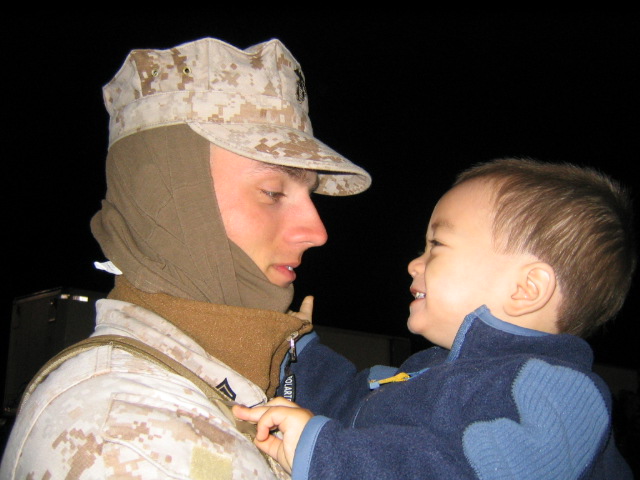
Hours before departing to Iraq.

“Empowerment” is another one of those key terms that business leaders like to refer to.  It is also used freely in military instruction when referring to influencing an organized group towards a common goal (leadership).  It is also one of those words that has a million caveats, what-ifs, how-tos, and no real black and white instruction to be read and understood.  As is every other article I’ve composed, I’m going to give my views and experiences on empowerment, and add what I feel is an important, and reinforcing supplement: Review and personal reflection.

Telling someone that you have the genuine confidence in them that they can achieve something is almost always a sure way to get results.  We learned that when we were told, “you can do it, I know it” the first time we balanced ourselves out on our bicycles without our training wheels.  I know I personally am more likely to achieve something I don’t think I could if someone else told me they thought I could, and then set me on course to do so.  Even more convincing is when I know I am being counted on to accomplish that task, or reach that goal.  Therein lies the difference between encouragement and empowerment.  You can encourage someone with confidence to achieve previously doubtful goals.  In order to empower someone, you must not only encourage, but place them in control of something that is being relied on by more than just that person’s desire for accomplishment.   They have to be given something that they know will be looked at as a product of their efforts, and then encouraged to “show us what you’ve got”.

There are two specific examples of my professional career where I felt the effects of empowerment as the subject who was empowered.  First, was when as a junior Corporal in the Marine Corps, I was placed in a billet well above my pay grade and assigned to those with 5+ more years of experience than I had at the time.  I was firing on all cylinders just to tread water at first.  A month into it, my Master Gunnery Sergeant, the highest ranking enlisted Marine in my trade had a talk with me.  He asked if I felt I need to have a Staff Non-Commissioned Officer assigned to my section (which rated 2 of them).  If I did, he would get one assigned.  But he then told me that he would be interested to see how I did in the role… and if I was up for the challenge, the “shop” was mine.  He said he didn’t expect me to be an expert to start, but expected me to do my best and he had confidence in me either way.  I asked for the chance.  The personal drive I had to be the absolute best at anything that pertained to the job I had or Marines I was leading was palpable.

The second example was while I was deployed to Iraq.  I was acting as a chief instructor for enhanced marksmanship.  My company Executive Officer (XO) and my  section Gunnery Sergeant (direct boss) said I was responsible for running a 2 day range, and that I would be instructing to subordinates, peers and senior ranked Marines that had not been introduced to the Enhanced Marksmanship Program.  I felt their confidence in me, and there was nothing I was afraid of more than making the XO or Gunnery Sergeant look bad by giving me the chance.  I had to prove they made the right decision.

I later was told by the XO that some of the senior Marines from the range I instructed approached him directly to mention their appreciation for the range and quality of instruction.  I was floored!  Then I was surprised… The XO sat me down with a video recording of the range and all the informal lectures I gave as a part of the shooting package.  He told me I received a lot of compliments, but, he wanted me to see what they thought was good.  He also wanted me to see myself, and see what I thought I could do better.  He provided his insight, but he gave me the chance to review myself.  I didn’t comprehend what he was doing at the time beyond face value… but I was able to reflect, and what he did was HUGE!  I was motivated with empowerment, and then held accountable for my choices, good or bad, and encouraged to do it all over again!  They told me they had confidence in me, that I was allowed and EXPECTED to learn at full speed, and that no matter how well I thought I ever did at anything, it could always be improved.

I never got to thank any of them for those lessons… but if they read this, they know who they are.

Master Guns, XO, Gunny,

Thank You.